
Gravel is the cheapest way to surface a driveway. That is exactly why it is the one most often done badly. Because the material costs so little, people assume the job is simple. Stone gets tipped onto the ground, raked out, and called a driveway. Two winters later it is mud with pebbles in it. A gravel driveway built properly is a completely different thing, and it is worth understanding what separates the two before you spend anything at all.
Most Gravel Drives Are Not Really Driveways
Loose stone on soil does not work. Cars push the gravel down into the ground, soil comes up through it, and within a couple of years you have a surface that rusts in wet weather and grows weeds everywhere.
A proper gravel drive is a built structure with a loose finish. It goes like this. The ground is dug out, usually to around 200mm. A geotextile membrane goes down on the formation, which matters more here than on any other surface because it is the only thing stopping stone and soil mixing. Then 100 to 150mm of MOT Type 1 goes in and is compacted in layers until it is solid. The decorative gravel is the last 50 to 75mm on top.
So the thing you can see and walk on is the thinnest part of the whole build. Everything holding your car up is underneath it.
What You Are Actually Paying For
Given all that, the gravel itself is one of the smaller lines on a quote. You are paying for the excavation and getting the spoil away, the membrane, the stone base and the machine time to compact it, the edgings, and the labour across all of it. The decorative topping is the cheap part.
This is why a gravel quote from someone who has cost the groundwork will look higher than one from someone planning to tip and rake. Both are called gravel driveways. Only one lasts.
Angular Stone or Rounded, and Why It Decides Everything
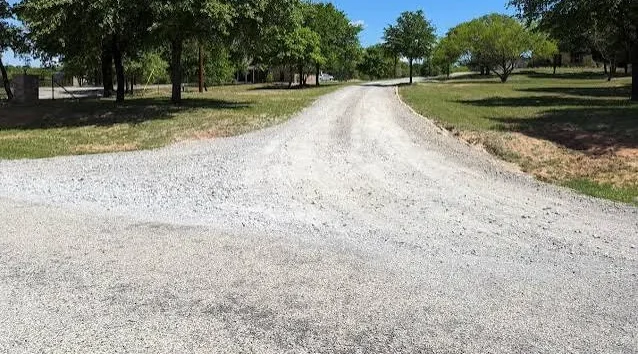
If you take one thing from this article, take this. Gravel for a driveway needs to be angular, typically around 20mm and single sized. Angular stone has flat faces and sharp edges, so the pieces wedge against each other and lock into a surface that holds together under tyres.
Rounded gravel, including the pea gravel people often pick because it looks softer, does not lock. It rolls. It moves out from under wheels, tracks across the drive, escapes into your lawn and ends up on the pavement.
It is in the same price bracket. It is simply the wrong stone, and it is the single most common reason a gravel drive is a disappointment.
Depth, and Why More Is Not Better
There is a natural instinct to put plenty of gravel down. Resist it. Around 50 to 75mm of loose stone over a compacted base is the sweet spot. Go much deeper and tires sink into it instead of riding on it, which makes the drive feel soft, causes rutting, and turns the wheel into hard work.
If your drive already feels like you are driving through a shingle, the answer is usually not more gravel. It is less gravel over a better base.
Edges, and When You Need a Grid
Gravel has no interlock at the perimeter, so it needs something holding it in. Timber, steel, plastic edging or concrete kerbs all work, but something has to be there or the drive slowly migrates outward.
Then there is the cellular grid option. These are honeycomb panels laid over the base and filled with gravel so each cell holds its stone in place.
A grid adds cost, and on a flat drive with the right stone you may not need one. But it becomes close to essential in three situations. On any noticeable slope, where loose gravel simply travels downhill. Where a wheelchair, pram or bike needs to cross the surface, because a filled grid gives a far firmer ride. And on a drive that opens straight onto a road, where escaping stone becomes someone else’s problem. Grids also let you run a shallower gravel layer, so some of the extra cost comes back in material.
What Pushes the Price Up
- Size. The dominant factor, as with any surface.
- Removing the old surface. Concrete or tarmac has to be broken out and carted away.
- Ground condition. Soft or waterlogged ground needs more stone below.
- Slope. A gradient usually means adding a grid system.
- Stone choice. Plain limestone and granite chippings sit well below decorative and coloured aggregates.
- Edging length. An awkwardly shaped drive has far more perimeter to restrain.
- Access. Tipping at the curb is quick. Borrowing everything down a passage is not.
The Running Costs Nobody Mentions
Gravel is the cheapest driveway to install and the least cheap to ignore. It needs raking every so often, particularly where you park and brake, because that is where the stone gets pushed away and a hollow forms. It needs topping up every few years as stone works down and out. Weed seeds land in the gravel and germinate, so it wants an occasional treatment. And snow clearing is genuinely awkward, since a shovel lifts as much stone as snow.
None of this is difficult. It is all work you can do yourself in an afternoon, which is part of the appeal. But it is real, and it never stops.
So Is It Worth It?
Honestly, it depends entirely on your drive and your patience. Here is where I land.
Gravel is a strong choice if you have a long or rural driveway where any other surface becomes expensive fast. If your budget is the deciding factor and you would rather have a properly built gravel drive than a poorly built tarmac one, which is the right instinct. If you have drainage problems, because gravel is fully permeable and lets water go straight down. And if you like the sound of someone arriving, which many people genuinely do.
Permeability is worth dwelling on. Because water passes through it, a gravel drive at the front of a house does not run into the planning rule that catches impermeable surfaces over five square metres, and it does not push rainwater into the road.
Gravel is the wrong choice if your drive slopes noticeably and you do not want a grid. If anyone in the house uses a wheelchair, a walking frame or a pram daily. If you want a surface you can forget about entirely for twenty years. Or if your drive opens directly onto a busy pavement where stray stone will be a nuisance.
The honest summary is that gravel gives you the lowest price for the best drainage, and asks for a little of your time in return forever. If that trade suits you, it is excellent value. If it does not, spending more once is cheaper than resenting it every spring.
Common Questions
How long does a gravel driveway last? The base lasts decades if it was built properly. The gravel on top gets topped up every few years, so the surface is renewable rather than replaceable.
Can gravel go over an existing driveway? Over sound concrete or tarmac, gravel needs edges and ideally a grid, or it will slide across a smooth surface. It is usually better to lift the old surface and build the base properly.
Will I get weeds? Some, from seed landing on top rather than growing from below, which is what the membrane prevents. Raking and an occasional treatment keeps it under control.
Is gravel noisy? Yes, and for many people that is a feature rather than a fault.
Have a Look at Your Ground First
Whether gravel is the right answer usually comes down to two things I cannot judge from here. How much your drive slopes, and what the ground underneath is doing.
Come out and I will tell you straight whether gravel suits your driveway, whether you need a grid, and what the base needs to be. If I think another surface would serve you better over the years, I will say so, even though gravel is the cheaper sale. Call Advanced Driveway Solutions on 07944680279 or email advanceddrives2020@gmail.com to arrange a visit. You will find us at 10 Altham Rd, Morecambe LA4 4UG, United Kingdom. Bring any other quotes with you and we will compare what each one includes below the stone.