
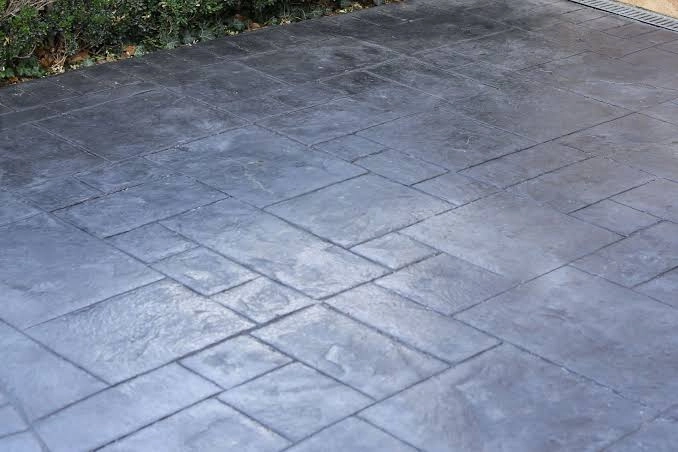
Imprinted concrete is the surface that gives you the most look for the least material. A single pour, stamped while it is soft, and you have something that reads as stone or brick from the pavement. It is also the least forgiving driveway to get wrong, and the reason is simple. There is only one chance to lay it. Once you understand that, every line on the quote starts making sense.
You Are Buying One Piece of Concrete
Block paving is hundreds of parts. Gravel is thousands. Imprinted concrete is one. That single fact drives everything. There are no joints for water to sit in, no sand to top up and nowhere for weeds to root, which is why the upkeep is so light. But it also means the whole driveway is poured, coloured, stamped and finished in one continuous run, by a crew who cannot stop halfway.
It has one more consequence you should know before you commit to an imprinted concrete driveway. A repair will always show. If a section cracks, or a utility company has to trench across it, the patch will never match the original colour and pattern. On block paving you lift blocks and the join disappears. Here you cannot. That is not a reason to avoid it. It is a reason to care a great deal about who lays it.
What Goes In Below
The concrete is the surface. The ground under it still does the work. Expect the drive to be dug out to around 200 to 250mm, spoil carted away, then 100 to 150mm of MOT Type 1 compacted in layers. On soft or wet ground that depth increases.
The slab itself is normally around 100mm for a domestic drive taking cars, more where vans or heavier vehicles are involved. It needs reinforcement too, either steel mesh set within the slab or fibres mixed through the concrete. Reinforcement does not stop concrete cracking, but it holds the slab together and keeps any crack tight rather than open.
The Lorry, and the Clock It Starts
Concrete arrives ready mixed on a wagon, and that shapes the price more than people expect. There is a minimum load, so a small driveway pays for concrete it does not use. The wagon needs somewhere to stand and a chute that reaches, and if it cannot get close enough the mix has to be pumped or borrowed, which adds cost and time.
Once that concrete is on the ground the clock is running and it cannot be paused. Everything after this point has to happen in sequence, on the day, in the right window. That is why you will see a larger crew on an imprinted concrete job than on almost any other driveway. You are paying for enough hands to finish the whole thing before it goes off.
Colour, Release and the Stamping Window
The colour is not mixed through the concrete. It goes on the surface. A dry shake colour hardener is broadcast over the wet slab and worked in, which gives the base colour and toughens the top few millimetres. Then a powdered release agent in a second shade goes down. It stops the mats sticking and leaves the darker tone in the recesses that makes the pattern read as real stone.
Then the mats go on. And this is the moment that decides whether you have a good driveway or an expensive disappointment.
Concrete has to be at exactly the right stage to stamp. Too wet and it will not hold the detail. Too firm and the mats barely mark it. The window is short, and it moves with the weather, so a warm breezy day and a cold damp one are completely different jobs.
Weather also decides whether the pour happens at all. Frost, heavy rain and strong sun all cause problems, so a firm that postpones on a bad forecast is protecting your driveway.
The Joints That Stop It Cracking
Here is the part most homeowners have never heard of, and it is where cheap quotes cut. Concrete shrinks as it cures, and shrinking concrete cracks. There is no version of this where it does not. What a good installer does is decide where.
Control joints are cut into the slab with a saw, usually within a day or two of the pour, at spacings worked out from the slab thickness and laid out to follow the pattern so they are barely noticeable. The slab then cracks along those lines, under the joint, where nobody sees it.
Leave the joints out and the concrete still cracks. It just chooses its own route, straight across the middle of your driveway. If a quote does not mention joints, ask about them.
Sealing Is Not Optional
Imprinted concrete has to be sealed. The sealer brings out the colour, locks in the release agent and protects the surface from water and salt.
It also needs redoing. Every two to four years is typical, and that is a genuine ongoing cost the other surfaces do not have in quite the same way. Let it go and the colour dulls, then the surface starts wearing.
One thing worth raising with your installer. Sealed concrete can be slippery when wet, so ask for an anti slip additive in the sealer. It costs very little and it matters on a sloped drive or anywhere near a step.
Water and the Planning Rule
Imprinted concrete is impermeable, so water has to run across it somewhere. Falls are built in before the pour, and the finished level has to sit clear of your damp proof course. If the water cannot reach a lawn, border or soakaway on your own land, you are into the rule that says more than five square metres of impermeable surface at the front of a house needs planning permission. Drainage work then appears on the quote, and it belongs there.
What Pushes the Price Up
- Size, though the minimum concrete load means small drives cost more per square metre
- Access, particularly if the wagon cannot reach and a pump is needed
- Removing the old surface, with concrete and tarmac the slowest and heaviest to clear
- Ground condition, since soft or waterlogged ground needs a deeper base
- Pattern and colour, where borders, contrasting bands and multiple mats mean more setting out
- Slab thickness and reinforcement, if vans or heavier vehicles use the drive
- Drainage, wherever the water has nowhere obvious to go
Where a Cheap Quote Finds Its Savings
- A thinner slab, or no reinforcement at all
- A shallow sub base, or one compacted in a single pass
- Control joints left out, or cut too far apart
- Less colour hardener, so the colour sits shallow and wears through
- A single thin coat of sealer, or none until you chase them
- No falls built in, so water sits on the finished drive
Every one of these looks perfect on the day. Most of them show within three winters.
Common Questions
Will it crack? Concrete always moves. Properly reinforced and jointed, it cracks under the joints where you will not notice. Skip either and it cracks wherever it likes.
How long does it last? Twenty years or more when it is sealed on schedule.
Can it go over an existing driveway? Not sensibly. It needs its own base and full slab depth, so the old surface comes up first.
How soon can I drive on it? Usually about a week, though your installer will confirm based on the weather at the time.
Get the Specification in Writing
For this surface more than any other, the quote should tell you four things. Slab thickness, reinforcement type, joint spacing, and how many coats of sealer.
Come out and I will look at your ground, work out whether a wagon can reach it, and give you a written quote that spells all four out. I will also tell you honestly if I think a modular surface would suit you better, because on a drive where services run underneath it often does. Call Advanced Driveway Solutions on 07944680279 or email advanceddrives2020@gmail.com to arrange a visit. You will find us at 10 Altham Rd, Morecambe LA4 4UG, United Kingdom. Bring your other quotes and we will check them against those same four points together.