
Fence panels are cheap. Anyone who has walked past a stack of them in a builders merchant knows that. So when a fencing quote comes back at several times the price of the panels, it can look like a lot of money for a day’s work. It is not, and the reason is that the panels are the least important part of what you are buying. Here is what the rest of it actually is.
The Posts Are the Fence
Panels do not hold a fence up. Posts do, and posts are where almost every fence in Britain fails. Walk down any street after a windy night and the fences on the ground are rarely broken panels. They are snapped posts, rotted through at exactly the point where the timber meets the soil. That is the wet line, and it is the weak point in any timber post.
You have two choices here and they lead to very different prices and very different lifespans. Timber posts are cheaper and they look better with timber panels. Treated properly and kept out of standing water they do a good job, but the clock is always running at ground level.
Concrete posts cost more up front and last far longer, because there is nothing in them to rot. Panels slot down into the slots rather than being fixed to the face, which also means a damaged panel lifts out and a new one drops in without touching anything else.
For most fences that will be there twenty years, concrete posts are the better spend. That single choice moves a quote more than anything else on it.
How the Posts Go In the Ground
This is invisible once the job is done and it is the difference between a fence that shrugs off a gale and one that leans by year three.
The rule of thumb is that roughly a third of the post height goes underground. For a six foot fence that means digging down around 600mm, for every post, along the whole run.
The hole is then filled with concrete or a rapid setting post mix, worked in and left to go off before any weight goes on it. Digging and concreting twenty post holes is a serious chunk of the labour on any fencing job.
You will also see metal post spikes offered, driven into the ground with the post slotted in on top. They are quick and they are cheap. A reliable fencing contractor will know that they also rely on the ground staying firm, which British soil does not, and they are one of the most common reasons a fence starts moving early.
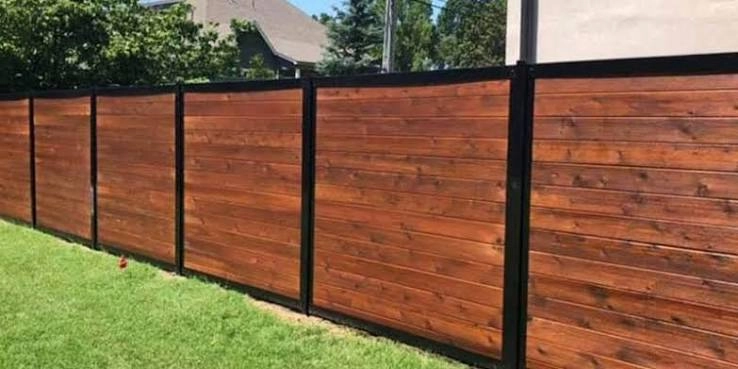
What You Are Choosing Between on the Panels
Overlap or waney edge panels are the cheapest. Thin boards stapled to a light frame. Fine for a low garden divide, not for anything exposed.
Closeboard or featheredge is the strongest option. Vertical boards overlapped onto horizontal rails, and at its best it is built on site rather than delivered as a panel. It costs more, it takes longer, and it will outlive everything else in the garden.
Tongue and groove gives a solid flat face with no gaps, which suits privacy and blocks wind, though a solid fence catches more of that wind and puts more strain on the posts.
Slatted and contemporary styles cost more for the look and let air through, which is easier on the structure.
The gap between a prefabricated panel and a fence built board by board on site is the biggest single difference in labour, and it is often what separates two quotes that look like they are for the same fence.
The Bottom Edge, and What Treated Really Means
Two things at the base of a fence decide how long it lives. The first is a gravel board. This is the strip running along the bottom, and its job is to keep the panel itself clear of soil and splashback. A concrete gravel board never rots and takes the wear that would otherwise attack your panels. Leave gravel boards out and the bottom of every panel sits in damp soil.
The second is how the timber was treated, and this is where quotes hide a lot of money.
Dip treated timber is dunked in preservative that soaks in a millimetre or two. It is cheap, and it is what most bargain panels are.
Pressure treated timber has preservatives forced deep into the wood under pressure. It costs more and it lasts far longer outdoors. They look almost identical when they arrive. The difference shows up around year six.
Your Ground Decides the Labour
Every fencing quote is really a guess about what is under your garden. Clay is heavy going. Rubble and old foundations stop a hole dead. Tree roots mean digging by hand and sometimes moving a post. And there is always the possibility of a cable or a water pipe running exactly where a post wants to be.
Access matters just as much. If everything has to be carried through a house or down a narrow side passage, including the old fence coming out and the spoil from every hole going in, the job takes far longer than the same fence with a gate wide enough for a barrow.
Slopes add cost too. A fence on a gradient is either stepped, with each panel level and a drop between them, or raked to follow the ground, which means cutting panels to a taper. Both need longer posts and more setting out than a fence on the flat.
Height, Boundaries and the Rules
Generally you can put up a fence to two metres without planning permission, but only one metre where it borders a road or footpath. That catches a lot of front gardens.
It is also worth being certain the boundary is yours before anyone digs. Deeds do not always say, and a fence in the wrong place is an expensive conversation with a neighbour. A quick word before work starts saves more trouble than anything else on this list.
What Pushes the Price Up
- Run length, and the number of posts within it
- Post material, with concrete above timber
- Panel type, especially closeboard built on site
- Removing the old fence, including breaking out old concrete post footings
- Ground condition, from clay to buried rubble
- Access, particularly rear gardens reached through the house
- Slopes, which need stepping or raking
- Gates, which are always more work than the equivalent length of fence
Where a Cheap Fence Quote Finds Its Savings
- Post spikes instead of concreted posts
- Shallow post holes
- Dip treated timber sold simply as treated
- No gravel boards
- Lightweight overlap panels on an exposed boundary
- Old fence and concrete left for you to dispose of
- Galvanised fixings swapped for whatever was in the van
Common Questions
How long should a fence last? Fifteen to twenty years and beyond with concrete posts, gravel boards and pressure treated panels. Five to ten with spikes and dip treated timber.
Whose fence is it? Check your deeds. There is no reliable rule about which side you own, whatever anyone tells you about the posts facing.
Can I fix a leaning fence rather than replace it? Often yes, if the panels are sound and only a post or two have gone. Concrete posts make that far easier in future.
Does the wind matter? A great deal. Solid panels catch far more of it, so an exposed boundary wants stronger posts or a design that lets air through.
Ask What Is Going Below Ground
The quickest way to judge any fencing quote is to ask three things. What are the posts, how deep are they going, and is the timber pressure treated.
Come out and I will measure the run, look at the ground and the access, and put a written quote together that answers all three. If part of your existing fence is sound and only a couple of posts have failed, I will tell you that rather than sell you a full replacement.
Call Advanced Driveway Solutions on 07944680279 or email advanceddrives2020@gmail.com to arrange a visit. You will find us at 10 Altham Rd, Morecambe LA4 4UG, United Kingdom. If you already have quotes, bring them and we will look at what each one puts in the ground.