
Tarmac has a reputation as the cheap option. That is fair on the material and misleading on everything else. The black you can see is the smallest part of what you are paying for. Most of a tarmac quote is groundwork, machinery, and a team working against a clock they cannot pause. Understanding that clock explains almost every difference between one quote and the next. So let us start there.
Tarmac Arrives Hot and Starts Dying Immediately
This is the thing that makes tarmac unlike every other driveway surface. It leaves the plant hot, and from that moment it is cooling. It has to be spread, levelled and rolled while it is still workable. Once it drops below temperature it will not compact properly, and tarmac that has not been compacted properly is a driveway that travels and potholes in a few winters.
Everything follows from that. The team cannot go slowly. The roller has to be on site and ready, not arriving later. The base has to be finished and signed off before a single load is ordered. Rain or frost can stop the job on the morning it was due.
So when you pay for tarmac, a good part of what you are buying is a crew and a set of machines all standing ready at the same moment.
The Part Underneath
Nothing about the black layer works if the ground below it is wrong. For a new driveway the ground is dug out to roughly 225mm below the finished level. That waste goes into skips or a grab lorry, and soil swells once it is broken up, so it fills more than the size of the hole suggests.
Then in goes the sub base. Between 100 and 150mm of compacted MOT Type 1, laid and rolled in layers rather than tipped in one go. On soft ground, clay, or anywhere holding water, that depth increases and sometimes a membrane goes in below it.
This layer carries the load. The tarmac on top is a surface, not a structure. Any quote where the groundwork sounds vague is a quote where the groundwork is thin.
Two Layers of Black, Not One
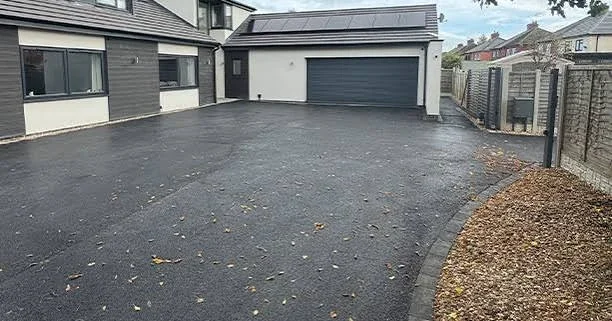
A proper domestic tarmac driveway is laid in two courses. The base course, sometimes called the binder, goes down first at around 50 to 60mm. This is the coarse structural layer that spreads the weight of your car.
The surface course goes on top at around 20 to 30mm. It is a finer material and it gives you the smooth closed finish you actually see. A 6mm surface course is worth asking for, because it holds up better against the scuffing modern power steering puts into a driveway when you turn the wheel while stationary.
You will meet quotes for a single layer of tarmac. It is not fraud and it is not always wrong on a very light use drive. It is simply less driveway. If two quotes are far apart, this is one of the first places to look.
Both courses have to be rolled hot with a proper roller, worked until the material stops moving. A plate compactor does not do this job.
The Edges
Block paving locks together. Tarmac does not. It is a continuous mat, and a mat with an unsupported edge crumbles from the outside in.
So the perimeter needs concrete edgings or kerbs, bedded and haunched in concrete, before the tarmac goes anywhere near it. On a drive that runs to a lawn or a border, that edging is the only thing holding your surface together. It is a real cost and it is one of the easiest things to leave out of a cheap price.
Falls, Drainage and the Planning Rule
Tarmac is impermeable. Water does not go through it, so it has to go somewhere across it. A fall of at least 1 in 60 is built into the base before laying. The finished surface also has to sit clear of the damp proof course on your house, normally 150mm below it, so water never bridges into the brickwork.
Then there is the planning rule. In England, laying more than five square metres of an impermeable surface at the front of a house needs planning permission, unless the runoff goes to a lawn, a border or a soakaway on your own land. Porous asphalt is the alternative that gets round it, but it needs an open graded stone base rather than standard Type 1, so it changes the groundwork as well as the surface. Any of this can add drainage work to your quote. It is not padding.
What Moves the Number Up or Down
- Size, and the minimum load. The paver, roller, crew and a hot delivery all have to turn up whether your drive is small or large. Small drives therefore cost noticeably more per square metre.
- Access. If the machine can get on the drive, the job is machine laid and consistent. If it cannot, the tarmac is borrowed and raked by hand, which takes longer and compacts less evenly.
- The old surface. Gravel scrapes off. Old concrete has to be broken out and carted away, and it fills skips fast.
- Ground condition. Soft or waterlogged ground needs more stone below before anything can go on top.
- Colour. Red, green and buff finishes use a pigmented binder and sit well above standard black.
- Weather. A washed out week means machines and a crew rebooked, and that has a cost somewhere.
Overlay or Full Rebuild
If you already have tarmac, you may not need all of the above. Where the existing base is genuinely sound, a fresh surface course of around 25 to 40mm can go straight over the top. No dig, no skips, far less material and one day rather than three. It is much cheaper and, on the right drive, it is the right answer.
The catch is that an overlay copies whatever is underneath. If the old surface is cracked, rutted or moving, those faults come back through the new layer within a couple of years. Cracks that run in lines, areas that flex under a car, or a drive holding water all point to a base problem, and a base problem needs digging out. Anyone offering to overlay without looking at how the existing drive behaves is guessing with your money.
Where a Cheap Tarmac Quote Finds Its Savings
If one price comes in well below the rest, it comes off somewhere. Usually here:
- One layer of tarmac instead of two, or a thinner surface course
- A shallow sub base, or one tipped and rolled in a single pass
- No edgings, or edgings sat on soil rather than concrete
- Hand laying and hand tamping where a machine and roller were needed
- No fall built in, so water sits on the finished drive
- Spoil left in a heap in your garden
None of it shows on the day the drive is handed over. All of it shows by the third winter.
Common Questions
How long does a tarmac driveway take? Two to three days for most domestic drives. Longer if drainage is going in or the ground needs extra work.
When can I park on it? Usually the same day once it has cooled, though it keeps hardening for several weeks. Avoid turning the wheel while stationary early on, and keep jack stands and caravan legs off it until it has fully set.
How long should it last? Fifteen to twenty years before it wants resurfacing, and longer if it is overlaid rather than left to break up.
Is tarmac cheaper than block paving? Per square metre, yes, and it goes down faster. Block paving wins on repairs, since a damaged block lifts and replaces invisibly while a tarmac patch always shows.
Ask What Is Going Under the Black
The quickest way to judge any tarmac quote, mine included, is to ask two questions. How deep is the sub base, and is it one layer of tarmac or two? Vague answers tell you plenty.
Come out and I will look at your ground, tell you honestly whether you need a full rebuild or just an overlay, and give you a written quote that lists each layer with its depth. If an overlay will do the job, I would rather sell you that than talk you into a dig you did not need. Call Advanced Driveway Solutions on 07944680279 or email advanceddrives2020@gmail.com to arrange a visit. You will find us at 10 Altham Rd, Morecambe LA4 4UG, United Kingdom. Already holding other quotes? Bring them and we will go through them together.