
Every spring it starts again. A few green shoots in the joints near the garage. By July there is a line of them running down the middle of the drive. You pull them. You spray them. You get the pressure washer out and blast the whole thing. It looks brilliant for a fortnight, and then they come back thicker than before. Here is the thing almost nobody tells you. The weeds are not the problem. They are a symptom, and once you understand what they are actually telling you, they become very easy to stop.
Your Weeds Are Not Coming Up From Underneath
This is the belief I have to undo more than any other. Under a properly built block paved drive there is 150mm or so of crushed stone, compacted until it is almost solid, usually over a membrane. Nothing pushes up through that. No seed germinates in it. There is no light and barely any air.
Your weeds arrived from above. Seeds blow in on the wind, drop off birds, fall out of overhanging shrubs, and get carried in on tyres and shoe soles. They land on the surface, which is exactly where they are supposed to land and do nothing. They only take hold if they find somewhere to sit. That somewhere is the joint.
Empty Joints Are the Real Problem
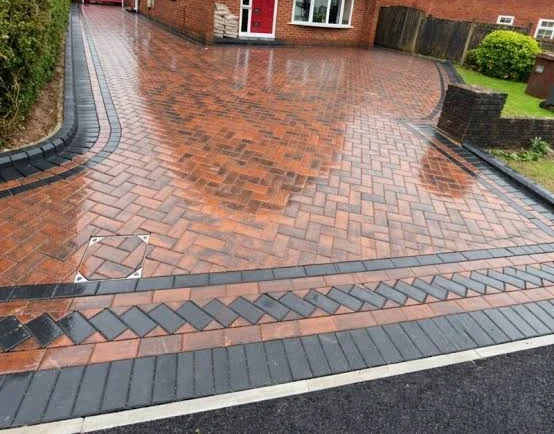
Every block on your drive is held by the kiln dried sand packed into the joints around it. Full joints do two jobs. They lock the blocks together so the surface behaves as one piece, and they leave nowhere for a seed to settle.
But that sand does not stay put forever. Rain washes the top of it away. Sweeping takes a little. Tyres turning on the surface grind some out. Over a few years the sand level drops and each joint becomes a narrow open channel.
Now dust, leaf litter and grit start collecting in those channels. That mix is not sand any more. It is soil, sitting in a warm sheltered slot with water running through it every time it rains. A professional Block Paving Service can identify and address these areas before they become established weed beds. It is a seed tray, running the full length of your driveway. That is why the weeds keep coming back in the same places. You are pulling the plants and leaving the seed bed.
Why the Pressure Washer Makes It Worse
I know how satisfying it is. You can see the clean stripe appearing behind the lance. The trouble is that a pressure washer does not stop at the surface. That jet drives straight down into the joints and strips the sand out, often to 20 or 30mm deep. You have just emptied every joint on the drive.
For a few weeks it looks immaculate. Then the joints refill with whatever blows in, and because they are now deeper and completely empty, the next crop of weeds roots better than the last one did. A strong jet also roughens the block surface, which gives dirt and moss more to grip. Pressure washing is not banned. Just treat it as the first half of a job. If you wash, you have to rejoint afterwards. Wash and walk away and you have made next year worse.
What Else Is Feeding Them
A few things quietly make the problem harder. Leaves and soil left sitting on the drive break down into exactly the growing medium weeds needed. A shaded corner that never dries out grows moss, and moss holds moisture that helps seeds germinate. Overhanging shrubs drop seeds straight onto the surface all summer. A dip that holds water after rain will always be the weediest part of a drive. And a garden border spilling soil onto the edge of the paving gives weeds a running start. None of these are dramatic. Together they decide how hard you have to work.
Deal With What Is Already Growing
Kill first, refill second. If you jam sand down on top of live roots you have simply buried the problem. For a handful of weeds, a weeding knife runs down the joint quickly and gets the root out. For a drive that is properly overgrown, a weed killer saves a lot of kneeling. Glyphosate based products are still legal for home use in Great Britain, though the approval is under review, so check the label and follow it exactly.
Boiling water works surprisingly well on small patches and is worth knowing about if you want to avoid chemicals near planting.
Do not use salt. It kills the weeds and then sits in your joints drawing moisture, damaging the blocks and poisoning anything growing nearby.
Whatever you use, wait until the weeds are properly dead and the drive is dry before you go any further. Roots left half alive will come back through fresh sand.
Refill the Joints Properly
This is the step that actually solves it, and it is the one most people skip. Pick a dry spell. The blocks and the joints both need to be genuinely dry, because damp sand bridges will not run down into the gap.
Tip kiln dried sand onto the drive and brush it across the surface in several directions, working it into every joint. Then go over the drive with a plate compactor with a rubber pad, or tamp it if the area is small. The sand will drop as it settles. Brush more in and repeat until the joints stay full and the sand sits just below the top of the blocks.
If you want to do this once rather than every year, ask about a polymeric or resin jointing sand instead. It goes in dry, then sets when it is wetted, so it resists washout and gives weeds nothing loose to root into. It costs more and it needs clean dry joints to bond properly, but on a drive that has fought weeds for years it is usually the better answer.
Sealing, and One Warning
A good sealer hardens the jointing sand, slows the washout and makes the whole surface easier to clean. Every two or three years is typical.
One caveat. Sealing reduces how much water passes through the surface. If your driveway is permeable paving, laid that way so it meets the planning rules, sealing it undermines the reason it exists. In that case leave the joints as they were designed and control weeds by keeping the surface swept.
When Weeds Mean Something Worse
Sometimes weeds are not a maintenance issue at all. If you refill the joints properly and they empty again within a season, something is moving. The usual cause is a failed edge restraint. When the concrete haunching behind the edge gives way, the outer blocks spread outward, every joint widens slightly, and sand pours out of all of them.
Water is the other tell. Weeds that cluster in one dip, or run in a line across the drive, are usually following standing water and a sunken base underneath.
Both of those need the paving lifting and the ground underneath putting right. No amount of sand fixes a base that is moving.
Common Questions
How often should I top up the jointing sand? Once a year on most drives, and always after any pressure washing.
Does a membrane stop weeds? It stops growth from below, which was never the main route in. It does nothing about seed landing on top.
Why are my weeds worse along one edge? That edge is either collecting debris off a border, sitting in shade, or losing sand because the restraint has weakened.
Is there a permanent fix? Close to it. Kill the growth, refill with a bonded jointing sand, keep the surface swept, and cut back anything dropping seed onto it.
Get Someone to Look Before Next Spring
If your joints keep emptying, or the same patch keeps coming back no matter what you put on it, the answer is under the blocks and no product on a shelf will reach it.
Come and I will walk the drive with you, tell you honestly whether it needs rejointing and sealing or whether a section needs lifting and relaying, and put it in writing. Plenty of drives I look at need a good afternoon of work rather than anything major, and I will say so if that is the case. Call Advanced Driveway Solutions on 07944680279 or email advanceddrives2020@gmail.com to arrange a visit. You will find us at 10 Altham Rd, Morecambe LA4 4UG, United Kingdom. Sort it in the autumn and you get a spring without the green stripe down the middle.