
Gravel is one of the most affordable and charming driveway surfaces you can choose. It looks natural, drains freely, and goes down quickly. There is one complaint I hear about it more than any other, though, and you probably know it well: the gravel never seems to stay where it is meant to. It creeps onto the pavement, scatters across the road, and gathers in the gutter, no matter how many times you sweep it back.
Here is the important part. Gravel that keeps escaping is not just bad luck, and it is not something you have to live with. It is almost always a sign that something about the driveway was not set up correctly. In this guide I want to explain exactly why gravel migrates, and walk you through what actually keeps it in place.
Why gravel wanders in the first place
Loose stone will always want to move a little, but a well-built gravel driveway keeps that movement to a minimum. When gravel is constantly ending up off your property, one or more of these causes is usually behind it.
The first and most common is a lack of edging. With no firm border to hold it back, gravel has nothing to stop it spreading outward every time a tyre or a foot pushes it toward the edge. Over time it simply migrates off the sides.
The second is the wrong type of gravel. Rounded stone, like pea gravel, behaves almost like tiny ball bearings. It rolls easily underfoot and under tires, so it scatters far more than angular gravel, which has flat faces that lock together and hold their position.
The third is too deep a layer of loose stone. It feels generous to pour on a thick bed of gravel, but a deep loose layer never firms up. Tyres sink in, the surface shifts, and stone sprays out to the sides. A shallower layer over a solid base stays put far better.
The fourth has no proper base underneath. When gravel is tipped straight onto soil or a soft, uneven surface, it has nothing to bind to. It mixes with mud, forms ruts, and moves around freely. A compacted sub-base gives it something stable to sit on.
The fifth is slope. On a driveway that runs downhill, gravity is working against you all day long, and gravel will always drift toward the bottom and out onto the road unless the surface is stabilised to hold it.
What actually keeps gravel in place
The good news is that every one of those causes has a straightforward answer. A gravel driveway that is built the right way can stay tidy for years with only light upkeep. Here is what makes the difference.
Solid edging is the first essential. A firm border of timber, metal, brick, or block paving around the driveway gives the gravel a wall to sit behind, so it cannot spread sideways onto your borders or the pavement. This alone solves a huge share of migration problems.
A gravel stabilisation grid is the biggest game changer of all. These are honeycomb panels, usually made from recycled plastic, that sit on the prepared base and hold the gravel in their cells. A gravel driveway contractor can install these grids to keep the stone locked in place rather than rolling around loose. This helps stop scatter, prevents ruts, and keeps the surface firm and even, even under regular traffic. If you want gravel that behaves, this is the single most effective upgrade.
Choosing the right gravel matters too. Angular stone in a sensible size, rather than smooth rounded pea gravel, grips and settles far better. The stones knit together instead of rolling apart, so the surface holds its shape.
Getting the depth right is just as important. Rather than a deep, loose bed, the gravel should sit as a controlled surface layer over a properly compacted sub-base. That combination gives you a firm drive that does not swallow tyres or spray stone.
Finally, a proper sub-base with a geotextile membrane underneath keeps everything stable. The membrane stops the gravel sinking into the ground and stops weeds pushing up through it, while the compacted base gives the whole surface something solid to rest on.
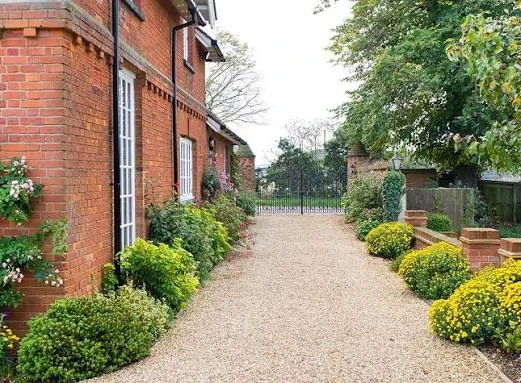
If your gravel drive already scatters
If you already have a gravel driveway that will not behave, you are not stuck with digging the whole thing up in most cases. Often the fix is adding what was missing in the first place. Fitting proper edging where there is none, raking the gravel back to an even depth, and retrofitting a stabilisation grid can transform a drive that constantly sheds stone into one that stays neat.
The right fix depends on why your particular drive is migrating, which is why it is worth having someone look at it properly rather than guessing. Sometimes it is a simple edging job. Sometimes the base needs attention. A quick assessment tells you which.
When to consider a firmer finish
For some homeowners, the honest answer is that they want the look of stone without any of the loose scatter at all. If that sounds like you, a resin-bound driveway is worth a thought. It uses natural aggregate bound together into a smooth, permeable surface, so you get that stone appearance with zero migration and no sweeping. It costs more than loose gravel, but for a busy driveway it can be well worth it. I am always happy to talk through whether gravel or resin suits your home better.
Why the base and the build decide everything
By now you can probably see the pattern. Whether gravel stays put or ends up in the road comes down to how the driveway was built, not to the gravel having a mind of its own. Edging, a stabilised and compacted base, the right stone at the right depth, and proper drainage are what separate a gravel drive that stays tidy from one that scatters endlessly.
This is the part that gets skipped when a driveway is laid quickly or cheaply. Someone tips a load of loose stone onto bare ground with no edging and no base, and the migration starts within weeks. Done properly the first time, gravel is a brilliant, low-cost surface. Done badly, it becomes a daily chore.
How I build gravel driveways that stay put
This is where experience earns its keep. With over 20 years laying driveways across Lancashire and the surrounding areas, we build gravel drives to hold their stone. We fit firm edging, prepare and compact a proper sub-base, lay a quality membrane, use the right gravel at the right depth, and fit stabilisation grids where they will make the difference.
My aim is to give you a gravel driveway that looks lovely, drains well, and stays where it belongs, without you chasing stones off the road every weekend. We keep you informed from the first quote to the final finish, use quality materials and proven methods, and price the work fairly. You get a driveway that stays tidy and hard-wearing, with none of the frustration.
Tired of sweeping gravel off the road?
If your gravel driveway will not stay put, or you are planning a new one and want it built to behave from day one, let’s talk it through before you commit to anything. I will take a look at your drive, explain what is causing the scatter, and give you a clear, no-obligation quote to put it right, with no pressure to book. You walk away with honest advice and a firm price, whether or not you decide to go ahead.
Ready to get started? Call Advanced Driveway Solutions on 07944 680279, or come and see us at 10 Altham Rd, Morecambe LA4 4UG. Let’s give you a gravel driveway that stays neat, holds together, and keeps its stone off the road for good.