
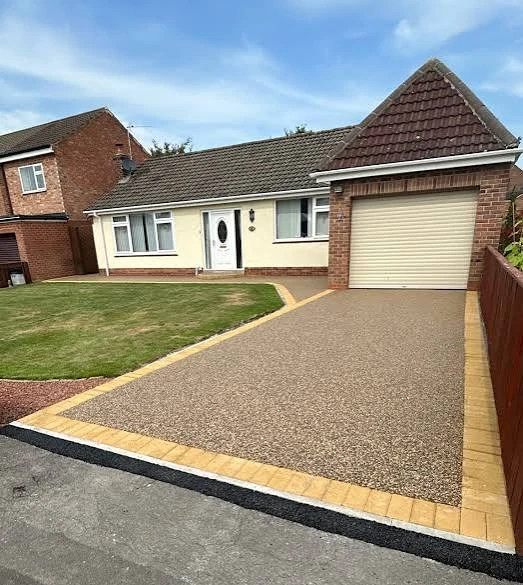
A resin driveway is one of the best-looking finishes you can put in front of your home. It is smooth, seamless, drains beautifully, and comes in a lovely range of colours. There is one detail, though, that decides whether your driveway still looks that good in a few years or turns into a disappointment, and most homeowners have never even heard of it. That detail is the type of resin used to bind it together.
Get it right and your driveway keeps its colour and charm for the long haul. Get it wrong and it can slowly turn yellow in the sun. In this guide I want to explain why UV stable resin is something you should never compromise on, and give you the exact questions to ask before you let anyone lay a resin driveway at your home.
What a resin driveway actually is
Let’s cover the basics quickly. A resin-bound driveway is made by mixing small stones, known as aggregate, with a clear resin, then trowelling that mix over a prepared base. The resin is the glue that holds everything together and gives the surface its smooth, hard-wearing finish. Because tiny gaps remain between the stones, water drains straight through, which is part of why resin is so popular.
So the aggregate gives you the colour and texture you see, but the resin is doing the real structural work underneath. And not all resin is the same.
The two types of resin, and why it matters
There are two main kinds of resin used on driveways. One is UV stable, often called aliphatic resin. The other is non-UV stable, usually an aromatic resin. They can look identical on the day the driveway is laid, which is exactly why this catches so many people out.
The difference shows up over time. UV stable resin is designed to hold its clear, true colour even under constant sunlight. Non-UV stable resin is not. When sunlight hits it day after day, it reacts and begins to change colour. That is the whole ball game, and it is why the resin choice is not a small technical detail. It decides how your driveway ages.
What happens when the wrong resin is used
When a non-UV stable resin is exposed to the sun, it yellows. The clear binder takes on an amber or yellow tint, and because that binder coats every stone, the whole driveway shifts colour with it. On darker aggregates the change can be harder to spot, but on the pale greys, whites, and light golds that so many homeowners love, yellowing stands out badly.
It usually starts within the first year or two and gets worse from there. The sunniest parts of the drive discolour first, so you often end up with patchy, uneven colour rather than a clean fade. Worst of all, it cannot simply be cleaned off, because the colour change is in the resin itself, not on top of it. Once it has yellowed, the realistic fix is to relay the surface. That is a lot of money and disruption to spend twice, and it is entirely avoidable.
Why some installers still use it
If UV stable resin is so much better, why would anyone use the other kind? The honest answer is cost. Non-UV stable resin is cheaper, so a driveway laid with it can be quoted at a lower price. For a homeowner comparing quotes side by side, that cheaper number looks appealing, especially when both driveways look the same on day one.
There are limited situations where a non-UV stable resin is acceptable, such as a fully shaded area or an indoor space out of the sun. An open driveway in the UK is not one of them. This is the classic trap of the cheapest quote. You save a little at the start and pay far more later when the colour turns. When a price looks surprisingly low, the resin is one of the first things worth questioning.
Why UV stability matters even in the UK
Some people assume our grey skies mean the sun is not strong enough to cause a problem. That is a myth worth clearing up. It is ultraviolet light, not heat, that triggers the reaction, and there is plenty of UV in British daylight even on cloudy days. Over the years your driveway spends outdoors, that exposure adds up.
On top of that, the light and airy aggregate colours that are so fashionable right now are the very ones that show yellowing most clearly. So the trend toward pale, bright driveways makes UV stable resin more important, not less. If you want that clean, modern look to stay clean and modern, the resin has to be able to hold it.
What to ask your installer
This is where you protect yourself. A good installer will welcome these questions and answer them clearly. Anyone who dodges them is telling you something. Before you agree to anything, ask:
- Is the resin you use UV stable, and is it aliphatic rather than aromatic?
- Will this driveway yellow or change colour over time in the sun?
- What warranty do you offer, and does it specifically cover colour and discolouration?
- Is the resin you are quoting suitable for the aggregate colour and the sun exposure my driveway gets?
- How will you prepare the base, and will the finished surface be fully permeable?
Write the answers down, and be wary of vague replies like “it will be fine” without any detail. The resin type and the colour warranty are the two answers that matter most. If those are solid, you are on the right track.
Why the whole install matters, not just the resin
UV stable resin is essential, but it is not the only thing that decides whether your driveway lasts. The base underneath has to be prepared properly, the resin and aggregate have to be mixed in the correct ratio, and the surface has to be laid at the right temperature and worked before it sets. Skip any of that and even the best resin will not save a poor job.
This is why the questions above are really about finding an installer who cares about the whole process, not just the price on the quote. The resin tells you a lot about how they work, and the rest of their answers tell you the rest.
How I make sure your resin driveway stays true
This is where experience counts. With over 20 years laying driveways across Lancashire and the surrounding areas, we use UV stable resin as standard, because I am not willing to hand you a driveway that could yellow in a couple of summers. We prepare the base properly, mix to the correct ratios, and lay the surface with care so it stays smooth, permeable, and true to colour.
My aim is to give you a resin driveway that looks as good in ten years as it does on the day it is finished. We keep you informed from the first quote to the final finish, use quality materials and proven methods, and price the work fairly. You get a driveway that holds its colour and its charm, with none of the regret.
Thinking about a resin driveway?
If you are planning a resin driveway and want it done with the right materials from the start, let’s talk it through before you commit to anything. I will walk you through your aggregate options, explain exactly what resin I will use and why, and give you a clear, no-obligation quote with no pressure to book. You walk away with honest advice and a firm price, whether or not you decide to go ahead.
Ready to get started? Call Advanced Driveway Solutions on 07944 680279, or come and see us at 10 Altham Rd, Morecambe LA4 4UG. Let’s give you a resin driveway that keeps its colour and its good looks for many years to come.